Data Center
1. Introduction
The Korea 4th Generation Synchrotron Radiation (Korea-4GSR) Accelerator can generate a large amount of data in a short time due to a dramatic increase in photon flux and coherence compared to the 3rd generation synchrotron radiation (3GSR). Korea-4GSR is expected to generate more than 1.5 PB annually with an initial 10 beamlines. For comparison, the 3GSR accelerator PLS-II at the Pohang Accelerator Laboratory, which operates 35 beamlines, generates about 1.4 PB annually, indicating a significant increase in data output per beamline.
The increase in data volume from the 4GSR beamlines cannot be solved by simply increasing storage capacity. Applying the small-scale data framework used for the 3GSR to the 4GSR would reduce efficiency in data analysis due to increased data processing time and management difficulties, delaying publication. Therefore, the 4GSR accelerator must provide computing resources to beamline users for fast data processing and have a system for stable data provision. Overseas institutions constructing or upgrading 4GSR accelerators are adopting strategies to handle large data volumes by linking with external data centers to reduce data generation load or by establishing their own data centers to upgrade IT infrastructure. Notable examples include the ESRF-EBS and SLS 2.0 in Europe, which supports beamlines and users online by establishing its own data center, and ALS-U and LCLS in the USA, which employ the Superfacility strategy by linking with the National Energy Research Scientific Computer Center (NERSC) to support beamline users [1-3]. Additionally, the NSLS-II at Brookhaven National Laboratory and the APS-U at Argonne National Laboratory are connected to supercomputers and high-capacity storage facilities on the same campus, while Japan’s SPring-8/SACLA forms a Big Value Chain involving Beamline Server - Beamline Storage - Analysis Support Institutions - User to provide flexible resources [4-8].
Similarly, the Korea-4GSR data center aims to support integrated solutions that provide data storage, management, and user-customized analysis environments necessary for large-scale data processing frameworks, beyond the simple storage server.
2. Roles of the Korea-4GSR Data Center
The main purposes of the Korea-4GSR data center are as follows (Figure 1):
Stable storage of large-scale data.
Systematic management of data generated by beamlines.
Provision of computing resources to beamlines and users.
Data Storage
The new framework introduced to the 4GSR accelerator involves upgrading the small-scale data algorithms and IT infrastructure used in the 3GSR to large-scale, but includes newly developed areas such as computing resource support, adding uncertainties. Additionally, the unclear data output size from beamlines makes it difficult to accurately predict the data center’s scale, potentially affecting the lead time for resource procurement. Therefore, the data center will be built through phased upgrades to minimize risks and prevent unnecessary resource and manpower waste.
The initial data center will use a distributed storage cluster system, considering fast data writing and capacity scalability. The initial storage scale is planned to be 3 PB, expandable up to 186 PB. Most beamlines will directly connect to the central storage of the data center, but beamlines with high-data rate such as Bio NX and High Energy Microscopy will store data on beamline storage and transfer it to the central storage during machine study or maintenance periods to ease instantaneous load on storage servers during user beam time.
Data Management
The synchrotron radiation accelerator contains information from the storage ring to the Front-End optics hutch and experiment hutch. This is called metadata, and unless the metadata not required for operation is specially recorded by beamline users or managers, most of it is lost. To prevent this, all metadata related to 4GSR operations and experiments is structured and stored in HDF5 format along with the measured data. The HDF5 format can be used regardless of the operating system [9].
Overseas, data storage periods, ownership, access rights, storage, and deletion follow established data policies. Although Korea-4GSR’s data policy has not been established yet, the initial phase will delete data due to limited storage space. For example, when 1/3 of the total storage capacity is filled, data will be deleted in the order it was created, with automatic notification emails sent 30, 15, 7, and 2 days before deletion to the email registered to the user’s account. If beamline users apply for an extension of the preservation period for data scheduled for deletion, a decision will be made after review.
User Support
To build a large-scale data framework, data management generated from beamlines and accelerators should be easy, and an immediate response structure to data processing requests should be established. Therefore, the data center will configure an HPC (High Performance Computing) system capable of processing mass data quickly, supporting a total of 480 CPU cores. The data center will also configure a network and management system to allow flexible use of HPC from all beamlines.
Experimental groups or researchers performing experiments at 4GSR will have their own user home directory, and will be supported to analyze data stored in the Korea-4GSR data center through web browser apps like Jupyter Hub. Since the initial network and HPC resources of the data center are not large enough to be provided simultaneously to multiple users accessing the external Internet, applications for resource utilization will be limited.
DAQ development support
When addressing the requirements for beamline development and operational support, there are two approaches that can be adopted. One approach is for the beamline itself to handle all requirements, including experiment control, data and metadata pipeline, data processing, data storage, and IT infrastructure. The other approach is to address the beamline’s requirements centrally. Each approach has advantages in terms of flexibility, innovation support, and standardization, but due to the limitations of Korea-4GSR’s human resources, a hybrid model is inevitably necessary.
The goal is to apply a standardized EPICS-based layout for each beamline DAQ (Data Acquisition). This allows new types of experiments to be implemented on other beamlines simply by porting. However, depending on the complexity, new EPICS-based system implementations may be required on other beamlines. In addition, the development and maintenance of interfaces independent of beamline dependencies are required. Therefore, to support beamline DAQ, it is essential to strengthen knowledge exchange between the beamline and the data center, enabling the review and support of migration ease and operational support levels/models.
3. Data Center Facilities
The data center will be located in Research Bldg. 1, with a dedicated area of about 150 m² and a total supplied apparent power of 220 kVA. The data center is divided into a network room that can accommodate 12 racks, a storage and HPC room that can accommodate 36 racks, and an office room to monitor the data center (Figure 2). The space accommodating the racks is equipped with air-cooled constant temperature and humidity control to minimize hardware failures by controlling heat generated from machines and blocking moisture, and it is separated from the office space. A 300 mm high raised floor is installed to form a floor cold air plenum, designed to withstand a load of 0.8 tons per square meter. Network trays are installed on the ceiling to consider wiring efficiency.
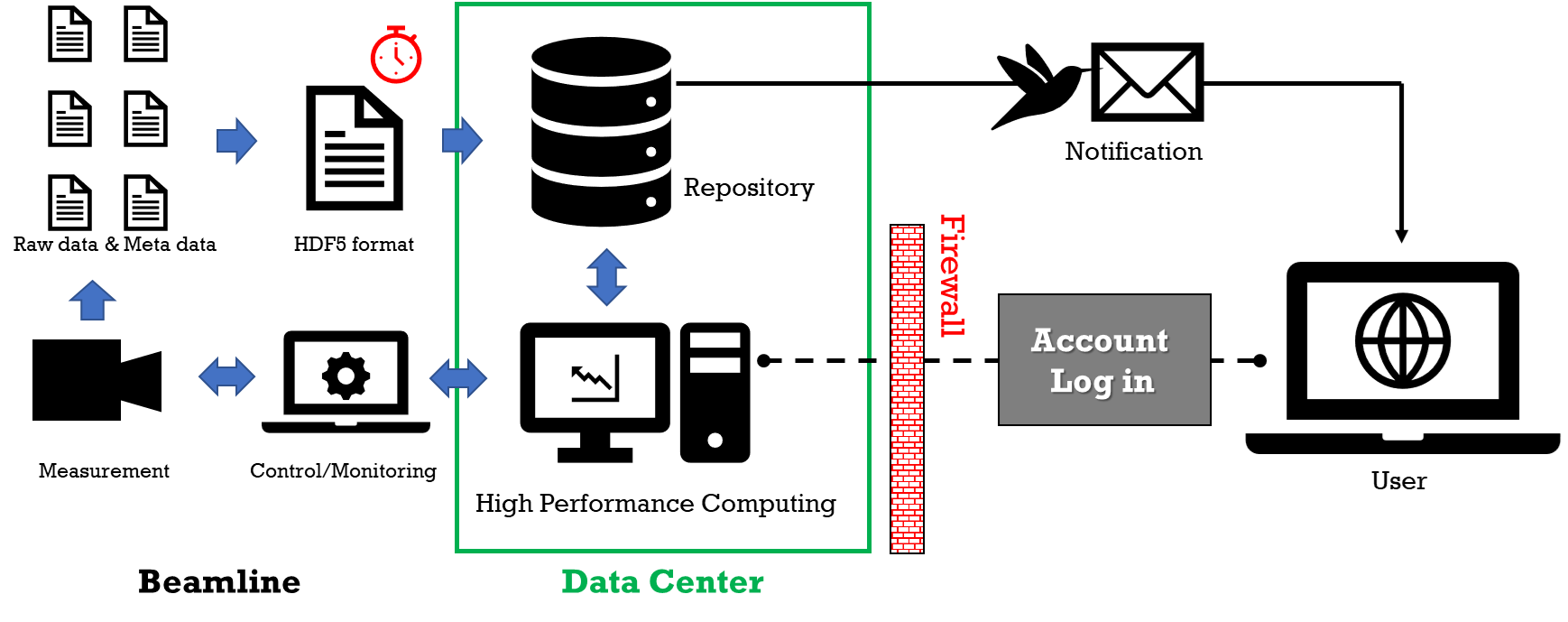
Figure 1 A schematic diagram of data management and user support
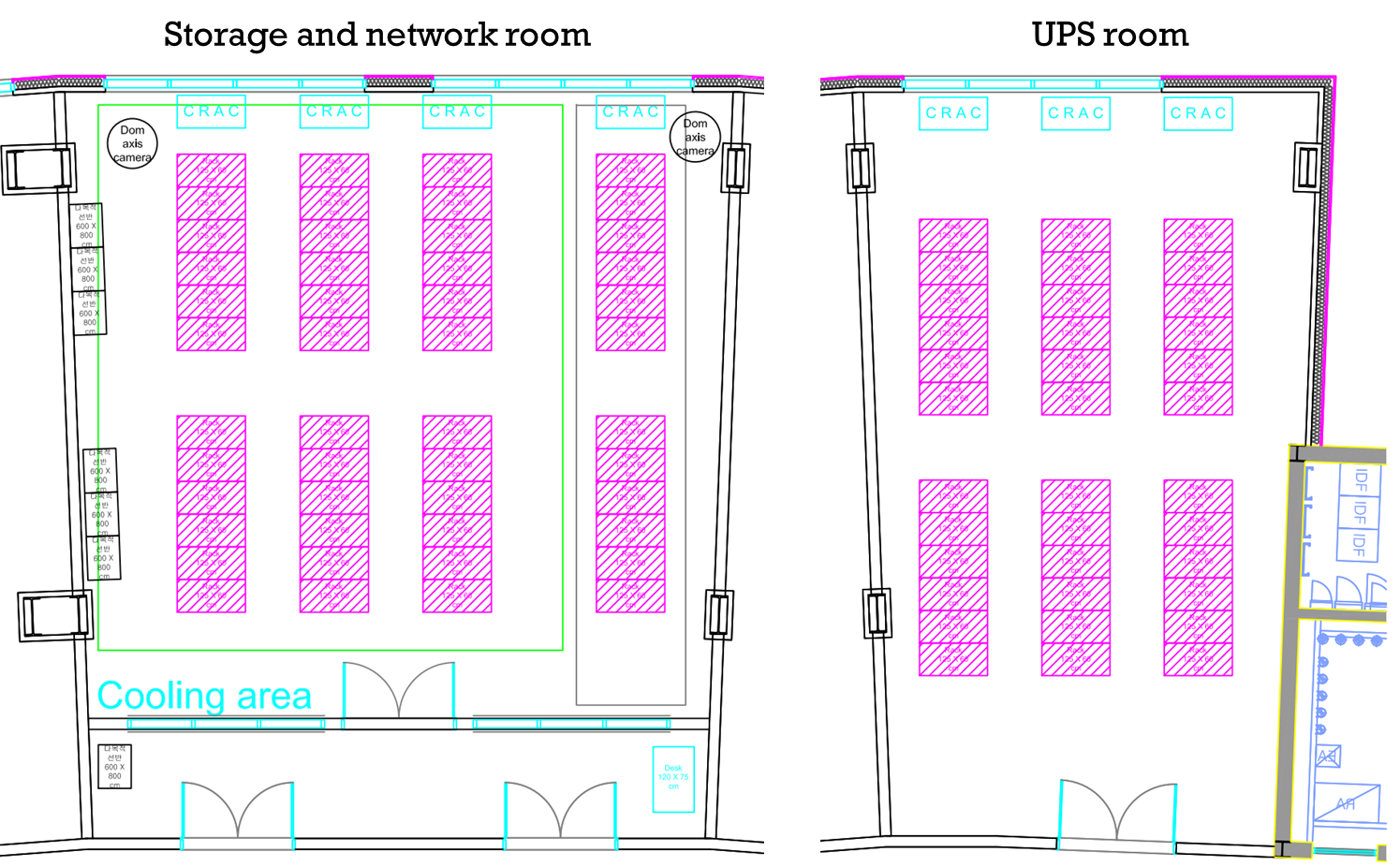
Figure 2 Korea-4GSR data center layout in Research Bldg. 1. The green rectangular space is for storage and HPC, while the gray rectangular space on the left is for network equipment racks. The pink diagonal area indicates slots where racks can be placed.
References
[1] https://www.esrf.fr/files/live/sites/www/files/about/information-material/ESRF_IT_Strategy.pdf
[2] Conceptual Design Report on Controls and Science IT for the SLS 2.0 Upgrade Project (2021).
[3] B. Enders et al., Cross-facility science with the Superfacility Project at LBNL (2020). 2020 IEEE/ACM 2nd annual workshop on extreme-scale experiment-in-the-loop computing
[4] The Advanced Photon Source Strategic Plan (2021).
[5] I. Latif et al., Finalizing Construction of a New Data Center at BNL (2021). EPJ Web of Conference 251, 02069
[6] 2023 NSLS-II Strategic Pan (2021).
[7] T. Hatsui et al., SPring-8 Data Center Initiative: Toward processing, analysis, and reuse of exabyte-scale scientific data (2023). HPCI
[8] K. Nakajima et al., (2022). J. Phys.: Conf. Ser. 2380, 012101
[9] M. Könnecke et al., (2015). J. Appl. Cryst. 48, 301